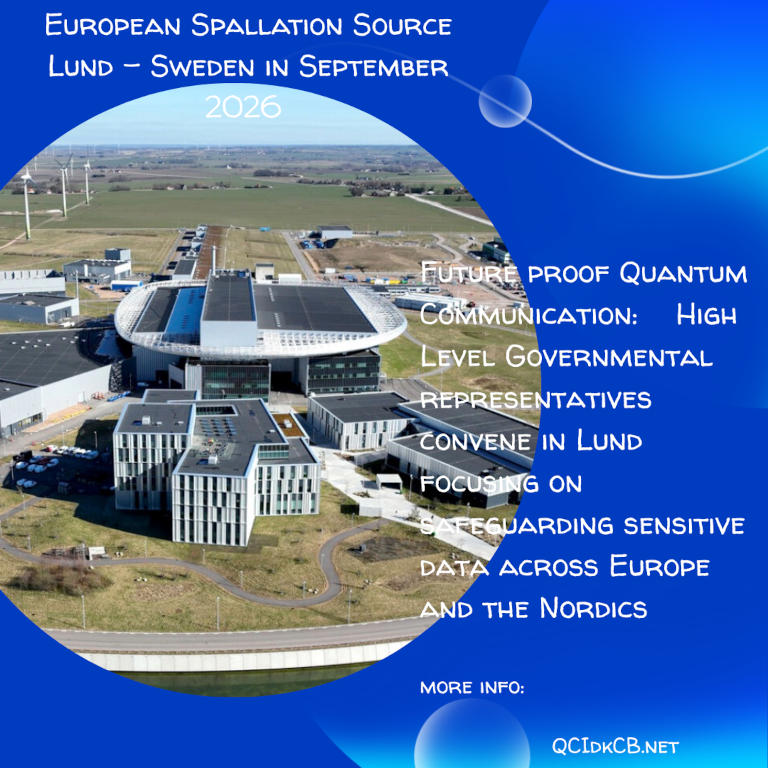
HIGH-Level Cross Border Quantum Meeting in Sweden, Governmental Representatives are discussing how to secure data flows across Northern Europe
Bridging the Nordics, Baltics, and Poland with Quantum Communication
The race to protect European digital sovereignty against future quantum threats is this week discussed across high level stakeholders in The Nordics.
As quantum Communication is no longer confined to isolated national labs the QCI.dk-Cross Border initiative is now taking the next massive step by connecting the existing national “islands” of quantum security across borders.
Supported by the European Health and Digital Executive Agency (HaDEA) under the EU’s CEF Digital programme, this Quantum project is building a 1240-kilometer quantum-secure infrastructure linking Denmark, Sweden, and Poland, and even Finland and the Baltics in the larger perspective by deploying subsea fiber-optic cables and testing co-existence with classical network data traffic.
“We are now turning the wider EuroQCI vision into an interconnected reality”, says Martin Bech, Head of the Danish NREN and coordinator of the initiative.
“As we drive this critical cross-border deployment, our work aligns directly with today’s shaping of Quantum Communication and Quantum Key Distribution (QKD), one of the most disruptive technologies when it comes to securing network”, Mr. Bech explains.
This does not exclude a ‘hybrid approach’ combining software-based Post-Quantum Cryptography (PQC) with physical, unhackable QKD keys to achieve ultimate data resilience.
Real-World Network Integration & co-existence is on the agenda and moving past lab experiments means integrating quantum tech into telecom infrastructure. A core part of the mission is testing how quantum signals can travel through the exact same fibers currently handling everyday data traffic.
Breaking distance barriers by using land-based fibers can only take quantum signals to a certain point. By establishing robust international links across the sea and anchoring regional hubs, cross-border projects like the QCIdk-CB lay the essential groundwork for the terrestrial layer of EuroQCI—eventually to be paired with space-based satellite segments, concludes Martin Bech.
The European Context
With the upcoming adoption of the European Quantum Act, Europe is moving aggressively to reduce technological dependencies and secure critical infrastructure before “Q-day” arrives - the day a quantum computer becomes powerful enough to break the current digital encryption. The EU’s strict timeline means critical sectors must transition to quantum-safe standards by 2030.
Through collaboration between researchers, national research networks, including Danish, Swedish, and Polish Research Network as well as private partners the project consortium is proud to co-build the secure digital highway that will keep Europe protected.
Anne Mette Persdotter